
Custom cufflinks and tie clip sets offer businesses a practical way to create coordinated men’s accessories for corporate gifts, weddings, formalwear retailers, promotional programmes, and private-label collections. By combining two complementary accessories in one product set, buyers can provide a consistent appearance while offering more value than selling individual items separately. Custom designs, logo engraving, personalised details, and coordinated packaging also allow businesses to develop products for specific customer groups.
For wholesalers and retailers, sourcing custom cufflinks and tie clip products requires careful consideration of design compatibility, materials, manufacturing capabilities, quality control, and packaging. A suitable manufacturing partner should understand how the two accessories work together visually and how to maintain consistent specifications across the entire order. Choosing an experienced custom cufflinks and tie clip manufacturer can help buyers coordinate product development, sampling, production, and delivery through a more organised process.
Why Choose Custom Cufflinks and Tie Clip Sets?
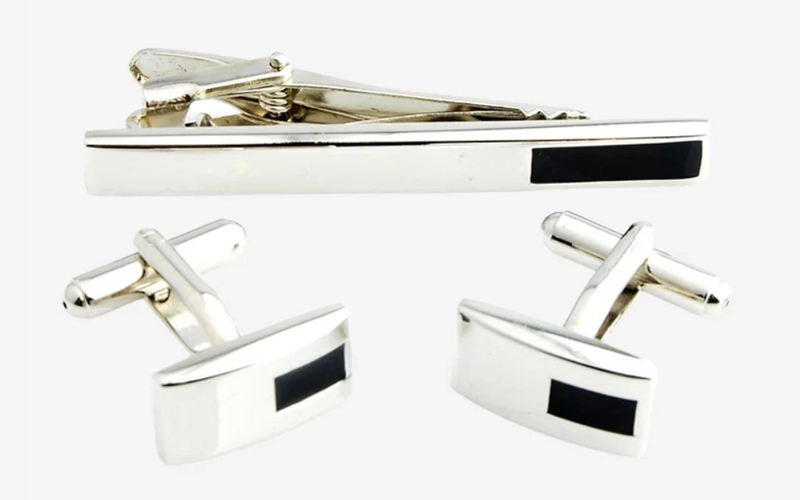
Cufflinks and tie clips serve different functions, but both contribute to a coordinated formal appearance. Cufflinks fasten compatible shirt cuffs, while a tie clip helps secure a tie and keeps it neatly positioned. When the two accessories share a similar finish, design language, or logo, they create a more unified presentation.
This combination is useful for several B2B markets. Wedding suppliers can offer matching accessories for grooms and wedding parties. Corporate buyers can develop gifts for employees, executives, clients, and business partners. Formalwear retailers can expand their accessory collections with coordinated sets, while promotional product companies can create branded items for events and recognition programmes.
Customisation also provides flexibility. Businesses can use initials, company logos, event symbols, geometric patterns, or other artwork to create products suited to their target customers. The same basic product structure can support multiple designs, making it easier to develop a collection without changing every manufacturing specification.
Coordinating the Design of Both Accessories
The most important design consideration is consistency. The cufflinks and tie clip should look like parts of the same collection, even though their shapes and dimensions differ.
A coordinated set can use the same surface finish, colour treatment, decorative pattern, or logo. For example, a company emblem may appear prominently on the cufflinks and in a smaller format on the tie clip. Alternatively, both accessories can feature a simple line pattern or matching geometric detail.
Buyers should consider the available decoration area on each item. Cufflinks may offer a compact, relatively symmetrical surface, while a tie clip generally provides a longer and narrower area. A logo that works well on the cufflinks may need to be resized or simplified for the tie clip.
A professional development process should evaluate both products together rather than approving each accessory independently. This helps ensure that the final set has a consistent appearance.
Materials and Surface Finishes
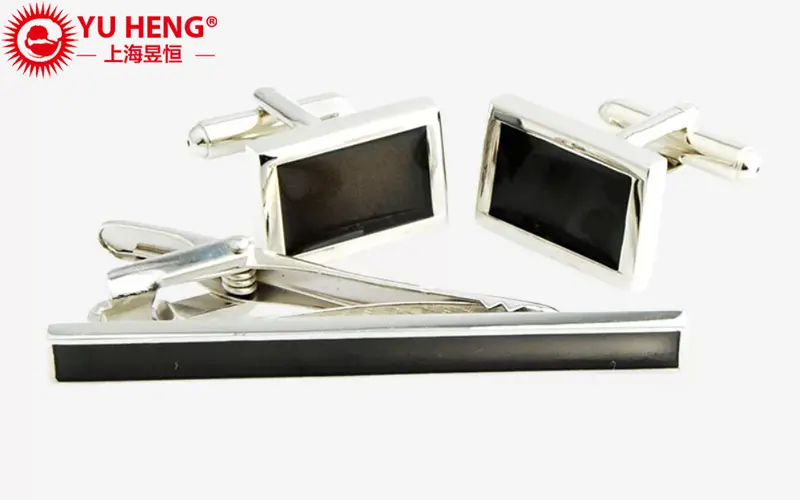
Material selection influences appearance, durability, weight, and production cost. Depending on the intended market and product specification, custom cufflinks and tie clip sets can be developed using suitable metal materials and different decorative finishes.
Common finish options may include polished, brushed, matte, or other plated appearances. The best choice depends on the design, target price, customer preferences, and the visual effect the buyer wants to achieve.
Consistency between the two accessories is particularly important. If the cufflinks and tie clip use different finishes, their colours or reflective properties may not match as expected. Buyers should therefore confirm the finish specifications for the complete set and evaluate them during sampling.
When requesting a quotation, provide the preferred material, finish, dimensions, and decoration requirements. Clear specifications help manufacturers prepare more comparable quotations and reduce misunderstandings during production.
Personalisation and Logo Customisation
Personalisation can make custom cufflinks and tie clip products more distinctive. Buyers may request company logos, initials, names, dates, symbols, or custom artwork. These details can be applied to one or both accessories depending on the design.
Engraving may be suitable for logos, initials, and other details that need a permanent mark. Other decoration methods may be appropriate for designs that require additional colours or different visual effects. The final choice depends on the product surface, artwork complexity, material, and desired finish.
Because tie clips are usually narrow, detailed logos and long text may require adjustments. The manufacturer should check the artwork against the actual decoration area before confirming production.
For larger orders, it is useful to establish standard artwork templates. These templates can define logo placement, maximum dimensions, spacing, and other specifications. Once approved, they provide a consistent reference for future production runs.
Working with a Custom Cufflinks and Tie Clip Manufacturer
Selecting the right manufacturing partner is essential for B2B projects. A custom cufflinks and tie clip manufacturer should be able to coordinate the design, specifications, production, and inspection of both accessories.
Relevant capabilities include reviewing artwork, recommending suitable materials and finishes, developing samples, managing production schedules, checking product quality, and arranging packaging. Buyers should also assess whether the manufacturer can accommodate their expected quantities and product variations.
Communication is particularly important when the set contains different decorative elements. If the cufflinks require one logo size and the tie clip requires another, these differences must be clearly documented. The manufacturer should understand the complete set specification before production begins.
For businesses planning repeat orders, it is beneficial to work with a partner that can retain approved samples and production records. This helps maintain consistency when the same set is reordered months later.
What to Expect from a Custom Cufflinks and Tie Clip Supplier
A reliable custom cufflinks and tie clip supplier should provide clear information about available designs, customisation options, minimum order quantities, sample procedures, production lead times, and packaging.
Buyers should not evaluate suppliers on price alone. A low quotation may exclude important elements such as custom artwork preparation, special packaging, or individual product boxes. Comparing quotations requires checking that each supplier is pricing the same specifications.
It is also worth asking how design changes are managed. A supplier should be able to explain whether adjustments affect sampling, tooling, cost, or delivery schedules. Clear communication at this stage can help buyers avoid unexpected changes after an order has been confirmed.
For wholesale businesses, the ability to manage repeat orders, maintain specifications, and respond to production questions can be just as important as the initial product price.
Sampling Before Bulk Production
Sampling allows buyers to check whether the proposed design works in a physical product. For coordinated sets, both accessories should be evaluated together.
Important inspection points include the overall dimensions, finish consistency, logo positioning, engraving clarity, attachment structure, and appearance of the complete set. Buyers should also check whether the tie clip operates as intended and whether the cufflinks are suitable for their intended shirt cuffs.
If the design includes a logo, the sample should be compared with the approved artwork. Small changes in scale or placement can affect the appearance of the finished product.
Any required adjustments should be completed before bulk production begins. Once the sample has been approved, the final specifications should be documented so that the production team has a clear reference.
Managing Wholesale Orders
Wholesale orders may include hundreds or thousands of sets, sometimes with multiple logos, finishes, or packaging variations. Clear order management helps ensure that each set contains the correct components.
Buyers should specify the quantity of complete sets rather than leaving the relationship between individual cufflinks and tie clips unclear. Product codes can be assigned to different designs, and packaging instructions should identify how the two accessories are to be presented together.
For orders involving several corporate customers or retail collections, a detailed order sheet can record each design, quantity, finish, logo version, and packaging requirement.
These procedures reduce the risk of mismatched components and help make repeat purchasing more efficient. They are especially useful for distributors and private-label businesses that need to manage multiple product variations.
Quality Control for Coordinated Accessory Sets
Quality control should cover each accessory separately and the complete set as a whole. Even if the cufflinks meet the agreed specifications, inconsistent colour or finish on the tie clip can affect the overall presentation.
Inspection may include checking dimensions, surface quality, finish consistency, logo placement, engraving clarity, attachment components, and visible defects. Functional checks should confirm that the cufflinks and tie clip perform their intended roles.
Packaging should also be inspected to ensure that the correct accessories are included and positioned properly. For personalised orders, product identification and artwork accuracy require particular attention.
Manufacturers can establish inspection checkpoints during production and before shipment. Documented specifications and approved samples provide a reference for evaluating the finished order.
Packaging and Private-Label Opportunities
Packaging is an important part of the product experience. A coordinated cufflinks and tie clip set can be supplied in an individual box, presentation case, or other packaging format appropriate to the target market.
Corporate buyers may require logo-branded packaging, while wedding suppliers may prefer presentation suitable for gifting. Retailers and private-label businesses may request printed inserts, product labels, or custom packaging designs.
Packaging requirements should be discussed at the beginning of the project because they can affect cost, production scheduling, and shipment preparation. Confirming the dimensions of both accessories also helps ensure that the selected box provides suitable protection.
For retailers, coordinated packaging can simplify product presentation and create a more consistent appearance across an entire accessory collection.
How to Prepare a Custom Order
Before contacting a manufacturer or supplier, buyers should prepare the following information:
- Preferred cufflink and tie clip designs
- Materials and surface finishes
- Product dimensions and functional requirements
- Logo artwork or personalisation details
- Decoration methods and placement
- Estimated quantity of complete sets
- Sample requirements
- Individual or branded packaging specifications
- Target delivery date
- Shipping and labelling requirements
Providing these details makes it easier for the manufacturer to assess the project, recommend suitable options, and prepare a more accurate quotation.
Conclusion
Custom cufflinks and tie clip sets allow businesses to offer coordinated men’s accessories for corporate gifts, weddings, formalwear retail, promotional programmes, and private-label collections. Their commercial value comes from combining complementary products with consistent design, customisation, and professional presentation.
Successful sourcing depends on careful design coordination, suitable materials, accurate sampling, organised bulk production, and consistent quality control. Choosing an experienced custom cufflinks and tie clip manufacturer can help buyers manage these requirements and maintain product consistency across repeat orders.
For wholesalers and retailers, working with a capable custom cufflinks and tie clip supplier can also simplify packaging, product development, and order management. By defining specifications clearly and evaluating samples before mass production, businesses can build a coordinated accessory collection that meets their customers’ needs and supports long-term sales.